What is Semantic Versioning?
Semantic Versioning (SemVer) is a standardized system for versioning software releases. It provides a consistent and meaningful way to communicate changes in your software, making it easily interpretable by both humans and machines.
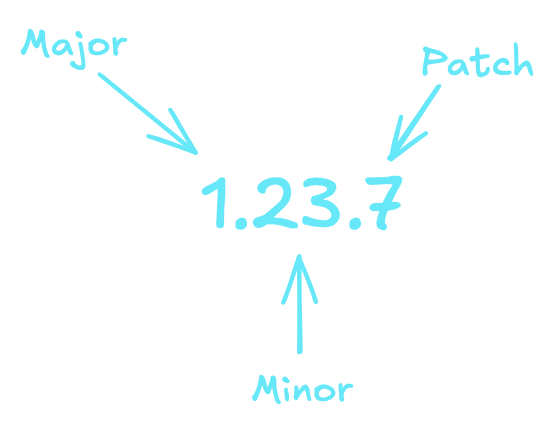
The SemVer format consists of three numbers separated by dots: MAJOR.MINOR.PATCH (e.g., 2.1.3)
- MAJOR version: Incremented for incompatible API changes
- MINOR version: Incremented for backwards-compatible new features
- PATCH version: Incremented for backwards-compatible bug fixes
Why is Semantic Versioning Important?
-
Clear Communication: SemVer allows developers to clearly convey the nature and impact of changes in each release.
-
Dependency Management: It helps in managing dependencies effectively, especially in package ecosystems like npm or PyPI.
-
Automated Tools: Many CI/CD tools and package managers can interpret SemVer, enabling automated updates and compatibility checks.
-
User Expectations: Users can quickly understand what to expect from a version update based on which number changes.
-
Debugging and Support: When reporting issues, precise version numbers help in identifying and resolving problems more efficiently.
Implementing Semantic Versioning
- Start with version 1.0.0 for your first stable release.
- Increment the appropriate number based on the changes made:
- MAJOR: for breaking changes
- MINOR: for new features
- PATCH: for bug fixes
- Reset lower-order numbers to zero when incrementing higher-order numbers.
Semantic versioning best practices
These are the rules that prevent the most common SemVer mistakes I see in real codebases.
Be honest about MAJOR. If a change breaks any documented public API, even by tightening a parameter type or removing a default, bump MAJOR. "It's only one caller" is how dependency hell starts. The point of MAJOR is that consumers can pin to it and trust nothing breaks underneath.
Pre-1.0 (0.y.z) is not "anything goes". The spec lets minor versions break before 1.0, but consumers still pin to your library. In practice, treat 0.y.z like 1.y.z: bump y for breaking changes, z for compatible ones. Hitting 1.0.0 should mean you are willing to be held to MAJOR/MINOR/PATCH semantics, not "I added enough features".
Tag every release in git. Annotated tags like v1.4.2, with CI/CD that publishes off the tag. Manually bumping a version field in package.json or pyproject.toml and forgetting the tag is the single most common reason a release is unreachable later.
Pair every version bump with a changelog entry. SemVer tells consumers that something changed, not what changed. A v2.0.0 jump is meaningless without a changelog explaining which APIs broke. Keep a Changelog format works well for this. Without the changelog, even a clean MAJOR bump forces consumers to read your diffs.
Use pre-release identifiers for risky releases. 1.0.0-alpha.1, 1.0.0-rc.2. These sort below 1.0.0 per the spec, so package managers will not pick them up by default. Use this for anything you are not yet willing to be held to.
Never reuse a version number. Once 1.4.2 is published, it is immutable. If something is wrong, ship 1.4.3. Force-pushing a tag, republishing the same version with different bytes, or "yanking and reuploading" all break consumers who already have the old artifact cached.
Build metadata: when to use it
The optional +meta segment in SemVer (for example 1.0.0+20130313144700 or 1.0.0+sha.5114f85) is for build identifiers that do not affect the public version. Common uses:
- Build timestamp or commit SHA, so a binary can self-report exactly what code shipped
- CI build number, for traceability across pipelines
- Internal flavor tags like
1.0.0+enterpriseor1.0.0+linux-arm64
SemVer build metadata is ignored for precedence. To a package manager, 1.0.0+a and 1.0.0+b are the same version. If two artifacts need to be ordered by build identity, encode that ordering in MAJOR.MINOR.PATCH or in a pre-release tag, not in build metadata.
Semantic versioning examples
Here is what a real project's release history looks like under SemVer:
Each bump tells consumers exactly what an upgrade will require: nothing for a PATCH, possibly some new behavior to opt into for a MINOR, and a migration for a MAJOR.
Conclusion
Adopting Semantic Versioning in your software development process enhances clarity, improves dependency management, and facilitates smoother collaboration among developers and users. By following this standardized approach, you can effectively communicate the evolution of your software and manage expectations around updates and changes.